
How Do Birds Sleep While Flying? What Frigatebird Research Reveals
Some birds sleep while flying. Explore the frigatebird EEG study, one-sided and bilateral sleep, rising air, and what the evidence actually shows.
Contents
- The study that recorded sleep during flight
- Why a bird with outstretched wings is not enough evidence
- What does sleeping with half a brain mean?
- What research on ducks adds
- Why sleep in both hemispheres matters
- How can a bird stay airborne without constantly flapping?
- Rising air is part of the frigatebird story
- How much do frigatebirds sleep in flight?
- A small average does not make every flight identical
- Do all migrating birds sleep in the air?
- Common swifts: long flights, a different measurement
- Short naps do not necessarily mean little total sleep
- Does REM sleep mean a bird dreams about flying?
- How to assess a claim about birds sleeping in flight
- A study map: keep different experiments separate
- What would a stronger test of a new question require?
- What questions remain open?
- Sources and review date
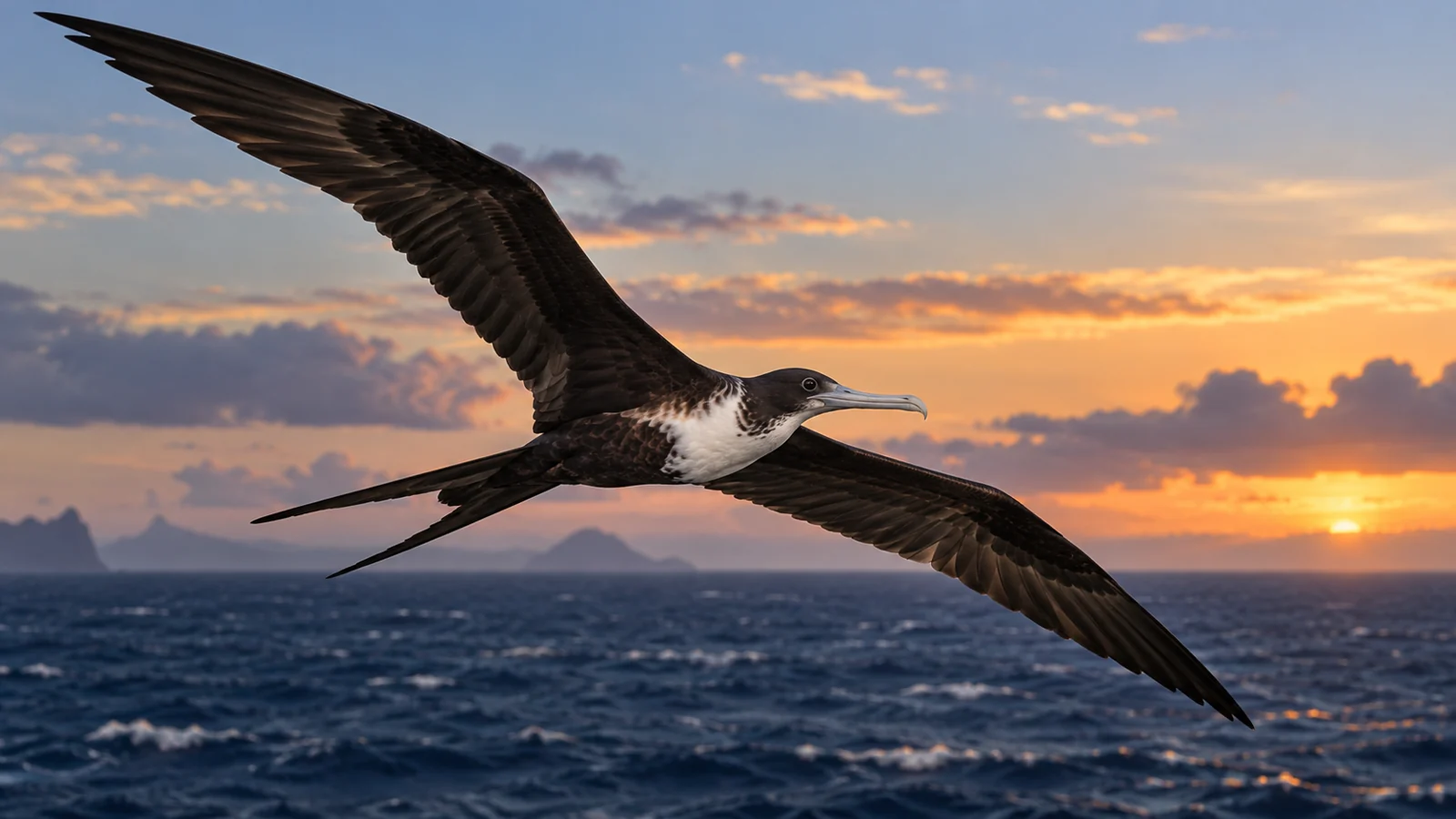
Some birds really can sleep while flying, and scientists have recorded it directly in great frigatebirds. But the familiar explanation that a bird “switches off half its brain and lets the other half fly” is incomplete: sleep was detected in both hemispheres at once, too. How these birds soar helps explain how they remain airborne; measuring brain activity tells us whether they are asleep.
The remarkable finding is not a bird spending the entire night deeply asleep over the ocean. It is an animal dividing sleep and wakefulness in a way that challenges our everyday picture of rest. To understand it, separate three questions: how did researchers establish that the bird was sleeping, how did its body stay in the air, and can the result be extended to every bird that makes long flights? Each question requires different evidence.
The study that recorded sleep during flight
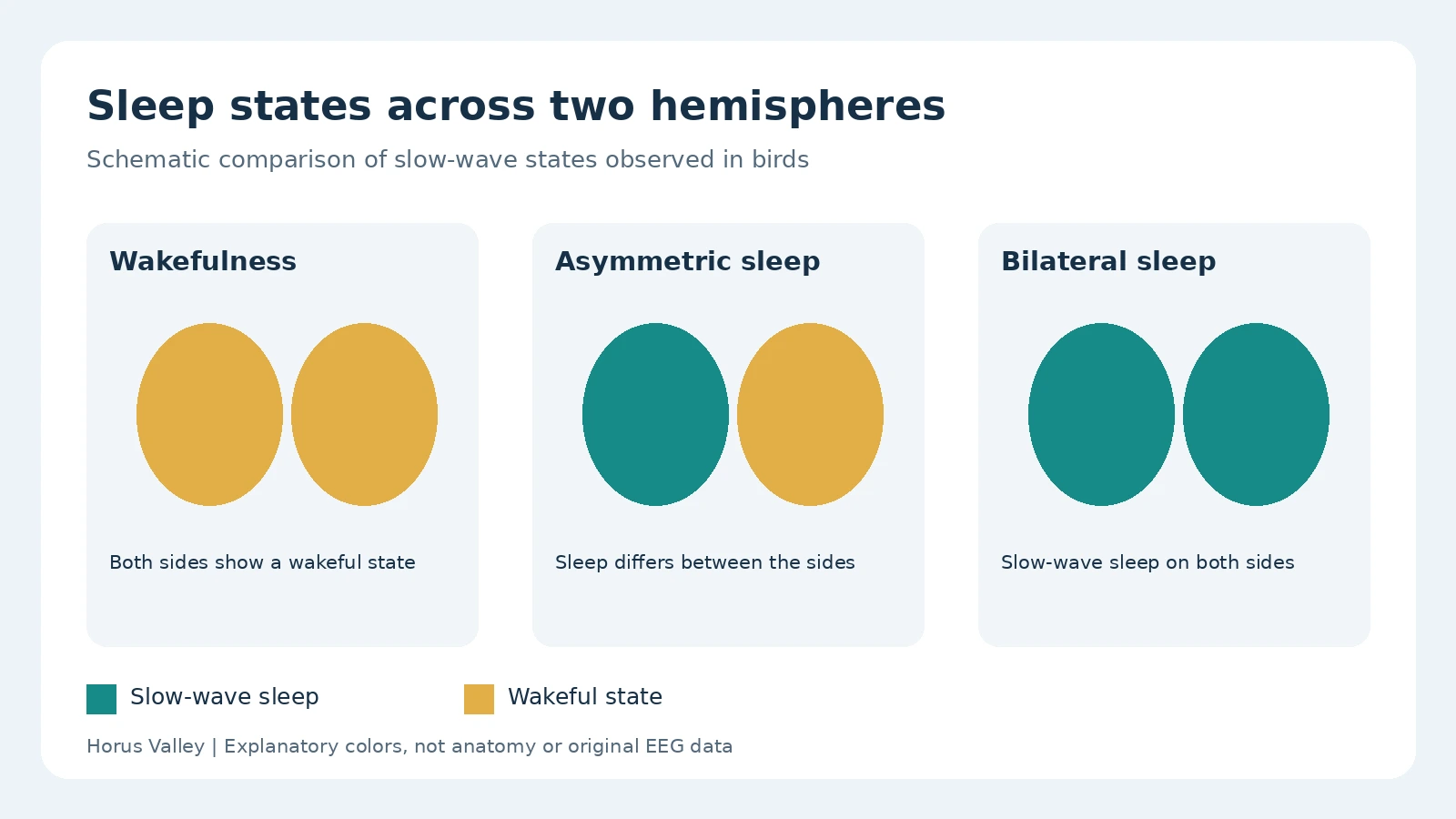
On August 3, 2016, a team led by Niels Rattenborg published a study in Nature Communications recording brain activity in great frigatebirds, Fregata minor, during ocean flights lasting up to ten days. The recordings revealed sleep in one hemisphere at a time and in both hemispheres together. According to the original research abstract, the birds slept for an average of approximately 0.69 hours per day in flight.
This is the starting point: a study published in 2016, rather than a new discovery in 2026. A recent article review date does not change the experiment’s publication year. Nor does evidence from frigatebirds make every account of a sleeping migrant a measured result. The species and the instruments used matter.
Why a bird with outstretched wings is not enough evidence
Imagine watching a distant bird glide smoothly with its wings extended. You can describe its posture and visible movement, but those observations alone cannot establish whether it is awake or asleep. An external view does not automatically reveal its brain state. Even a clear video is not a neural recording simply because the bird appears motionless.
That is why combining measurements matters. The Max Planck explanation of the experiment describes recording electrical activity from both brain hemispheres and head movements alongside position and altitude tracking. This allowed researchers to relate brain state to the bird’s movements, instead of classifying every quiet period as sleep.
| Observation or instrument | What it helps establish | What it cannot establish alone |
|---|---|---|
| Photograph or video | Visible posture and movement | The brain’s sleep stage |
| Position and altitude tracking | The bird’s route and location | Sleep during every quiet stretch of flight |
| Movement sensor | Changes in recorded movement | A definitive neural explanation for every period of stillness |
| Brain recordings linked to movement | Whether sleep patterns occur during flight | Dream content or every mechanism of flight control |
This distinction is useful well beyond bird research. When a science report says that a device “monitored” an animal, ask what it monitored: location, movement, or neural activity? Each study may answer its own question well. Problems arise when a measurement is treated as an answer to a different question.
What does sleeping with half a brain mean?
It does not mean that half the brain stops working like a switched-off light. Unihemispheric sleep describes a difference in sleep state between the two sides, particularly during slow-wave sleep. Rattenborg’s review “Sleeping on the wing” discusses how this phenomenon relates to sleep and wakefulness during long flights.
A better mental picture is an uneven distribution of neural sleep states, rather than one inactive half and another doing everything. It is also misleading to reduce the concept to closing one eye. Eye position is a behavioral observation that can be related to appropriate recordings; it is not a substitute for them in every species and setting.
What research on ducks adds
The 1999 study “Half-awake to the risk of predation” provided evidence that birds can adjust their use of unihemispheric sleep according to predation risk and detect an approaching threat during that state. This shows that an uneven distribution of sleep and wakefulness can relate to the need to monitor the surroundings.
The comparison has limits. Responding to a threat while resting on the ground is a different task from controlling a body soaring over the ocean. Duck research helps explain asymmetric sleep, but it cannot replace recordings from a bird in flight. Similarities guide scientific questions; measurements establish whether and how an explanation applies in another setting.
Why sleep in both hemispheres matters
It rules out an appealing universal explanation: “The bird stays airborne because the other half is always awake.” If bilateral sleep also occurs, one wakeful hemisphere cannot be the sole requirement for every observed episode of continued flight. That is a logical implication of the recorded states, rather than proof that every alternative neural mechanism has been explained.
The next questions become more precise. Which conditions allow flight to continue during a particular sleep state? How do monitoring, balance, and steering contribute? Separating those functions is more useful than calling all of them “piloting,” a word that suggests a tiny operator inside the head and obscures the remaining uncertainties.
How can a bird stay airborne without constantly flapping?
Flight does not always require continuous wingbeats. During gliding, extended wings move relative to the air and aerodynamic forces continue to act. NASA’s explanation of the forces on a glider describes weight, lift, and drag. Without continuous propulsion, lift does not simply disappear. However, maintaining altitude still requires an appropriate energy source.
In still air, a gliding body can trade height for forward movement and gradually descend. If the surrounding air is rising, it can carry the glider upward: losing height relative to the air need not mean losing height relative to the ground. This is a simplified physical explanation, rather than a numerical simulation of a particular frigatebird’s route.
Rising air is part of the frigatebird story
A separate 2016 paper in Science examined great frigatebird movements and their use of atmospheric conditions. It described using thermals and winds to gain height, followed by long glides at low energetic cost. The study of atmospheric tracking provides context for this way of traveling.
There are two complementary questions here. Air currents and wings help explain how the body remains supported; brain recordings test whether the bird is sleeping. A rising air current does not prove sleep, and recorded sleep does not suspend the laws of motion. Considering both is more informative than treating either as a complete explanation.
As a limited analogy, consider a paper glider after launch. It does not need a hand pushing it at every moment, but it still experiences forces and cannot continue forever without an energy source. The analogy concerns movement and lift only. A bird is a living animal that controls its body; a paper model cannot explain its brain or establish its sleep state.
How much do frigatebirds sleep in flight?
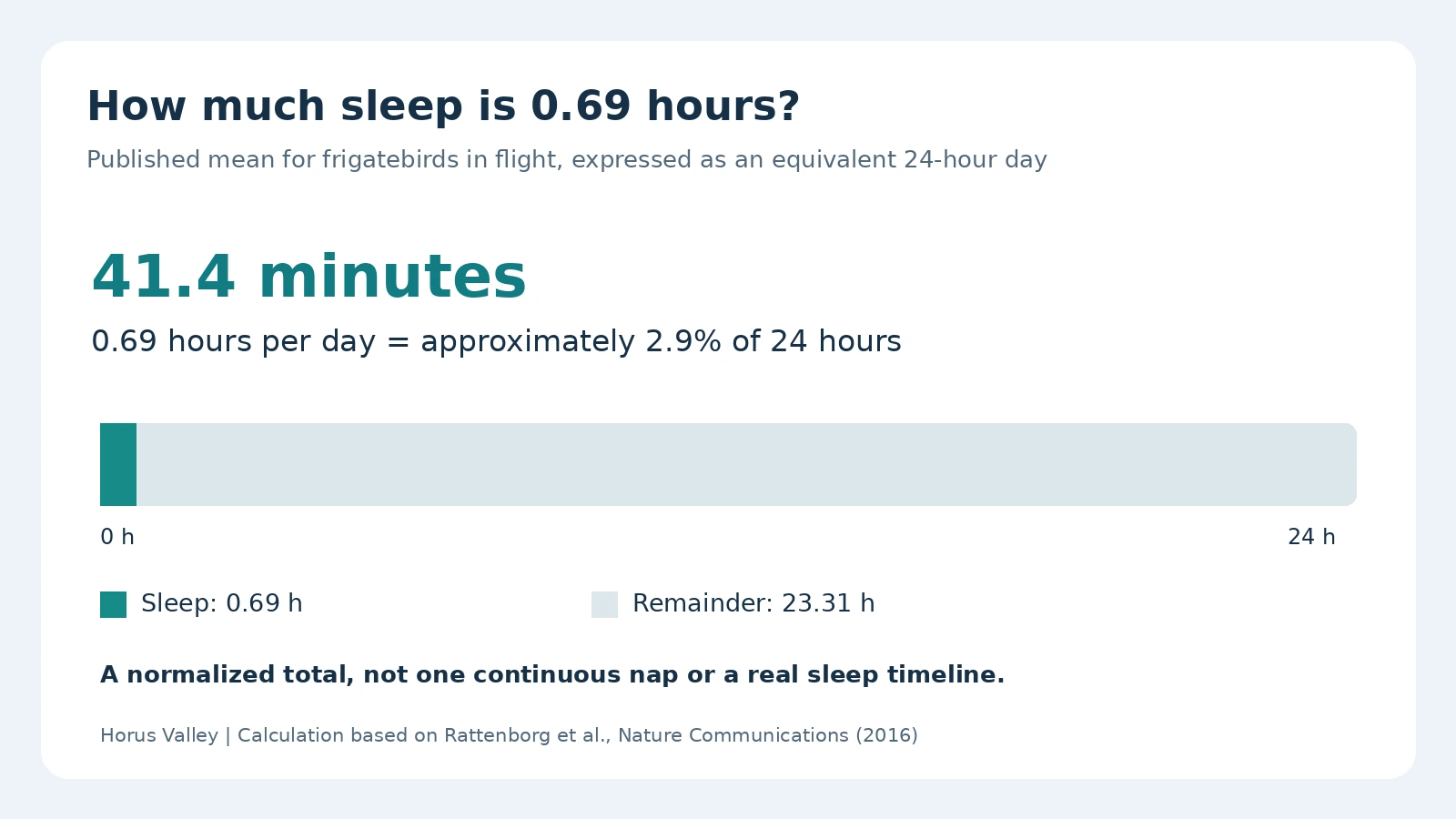
The study abstract reports an average of 0.69 hours per day. Converting that figure gives 0.69 × 60 = 41.4 minutes, or approximately 41–42 minutes in an equivalent 24-hour day. This restates a published average. It does not describe a bird taking one uninterrupted 41-minute nap at a fixed time.
| Presentation | Calculation | Correct interpretation |
|---|---|---|
| Minutes per day | 0.69 × 60 = 41.4 minutes | Approximate daily equivalent of total sleep |
| Share of a full day | 0.69 ÷ 24 × 100 ≈ 2.9% | A share of 24 hours, rather than nighttime alone |
| Calculated remainder | 24 − 0.69 = 23.31 hours | The remainder of this equivalent day outside the displayed sleep total |
These calculations do not reanalyze the original bird data or add precision to the published value. Since 0.69 hours is already rounded, 41.4 minutes should not be presented as an exact stopwatch measurement for every individual. The purpose is to give readers a visual scale while preserving the meaning of a daily average.
A small average does not make every flight identical
Different hypothetical schedules can produce the same total: many short bouts, or fewer relatively longer ones. A daily total alone cannot tell you how often sleep occurred or how it was distributed. Placing a small sleep segment at the beginning of a chart is a graphic arrangement, not evidence that sleep happened continuously at the start of the day.
The Max Planck account describes little, fragmented sleep in the air compared with sleep on land, including brief episodes of rapid eye movement sleep. “Sleeping while flying” therefore accurately describes the existence of the behavior. It does not mean that life in the sky provides the equivalent of an ordinary, uninterrupted night’s rest.
Do all migrating birds sleep in the air?
Flight duration cannot answer this on its own. The essential distinction is between documenting time airborne and recording sleep state. A lengthy flight may suggest a need for some form of rest, but that expectation does not measure its amount or type. Migration alone does not justify a list claiming that multiple species sleep in exactly the same way.
Common swifts: long flights, a different measurement
In 2016, Lund University reported tracking common swifts, Apus apus, with some individuals remaining airborne for up to ten months. The university’s account describes miniature activity loggers. This is an important finding about aerial lifestyles, but an activity logger does not become an electrical brain recorder.
When comparing these findings, ask about the measurement rather than which duration sounds more impressive. The frigatebird study recorded sleep during flight; the swift study documented prolonged time airborne. Species identification matters, too. Common swifts and swallows are different birds, even if their silhouettes look similar to a casual observer.
| Example | Evidence discussed here | Limit of the comparison |
|---|---|---|
| Great frigatebird | Brain activity during flight | Does not automatically generalize to every species |
| Common swift | Activity recordings and time airborne | Flight duration alone does not identify sleep stages |
| Ducks in predation research | Asymmetric sleep and threat monitoring | A resting context, rather than a flight experiment |
| Penguins in microsleep research | Recordings of highly fragmented sleep | Does not concern sleep during flight |
Short naps do not necessarily mean little total sleep
A separate 2023 Science study helps distinguish two frequently confused quantities: the length of one sleep bout and total daily sleep. Researchers observed chinstrap penguins taking microsleeps averaging about four seconds, repeated often enough to accumulate more than 11 hours of sleep per hemisphere each day, according to the research abstract.
Penguins cannot fly. Their relevance here is the mistake of inferring a total from the length of an individual bout. “Seconds-long naps” and “little daily sleep” are different claims. A comparison with frigatebirds requires attention to the total, distribution, and definition of sleep in each study, rather than simply placing two birds beside two striking numbers.
Does REM sleep mean a bird dreams about flying?
In 2023, researchers examined sleeping pigeons using functional magnetic resonance imaging alongside video monitoring. The Max Planck account described REM-related activity in areas involved in processing visual and bodily information and raised the possibility of dream experiences related to flight.
The key word is “possibility.” Activity in a brain region does not provide a verbal account of an animal’s experience or a script for its dream. Pigeons studied under imaging conditions also cannot stand in for frigatebirds flying over the sea. Similar sleep stages make comparisons interesting without establishing identical experiences across species.
When reading such findings, pay attention to researchers’ verbs: “recorded,” “suggest,” and “may” express different degrees of certainty. Those distinctions matter more than a dramatic photograph or headline.
How to assess a claim about birds sleeping in flight
- Identify the species. A general label such as “birds” can conceal substantial differences.
- Check the study date. Republishing a story does not make the experiment new.
- Find the measurement. GPS tracking is different from EEG, just as behavioral video differs from brain imaging.
- Define the number. Is it a daily total, a sleep-bout duration, flight time, or a proportion of a sample?
- Separate observation from explanation. Recording sleep does not fully explain every function of sleep or mechanism of flight.
Consider the hypothetical claim: “This bird flies for a month, so it sleeps in the air for a month.” The conclusion does not follow: flight duration is not sleep duration. The reverse claim, “It kept moving, so it did not sleep,” also bypasses the need to measure neural state. Both add a conclusion beyond the stated observation.
A study map: keep different experiments separate
Several species and dates appear in this subject because no single experiment answered every question. The table connects each finding to the question it addresses here. Dates refer to the cited publication or scientific announcement, rather than the origin of a behavior in nature.
| Year or date | Research topic | Question addressed here |
|---|---|---|
| 1999 | Asymmetric sleep and predation risk | Can sleep and wakefulness be distributed to support monitoring? |
| July 2016 | Frigatebird movements and atmospheric conditions | How do birds use moving air during long journeys? |
| August 2016 | Frigatebird brain activity in flight | Does sleep actually occur during flight? |
| October 2016 | Common swift aerial activity | How can prolonged time airborne be documented? |
| 2017 | “Sleeping on the wing” review | How do these findings relate to broader sleep research? |
| 2023 | Separate pigeon and penguin studies | How do sleep state, possible dream content, and fragmented rest differ? |
Putting experiments in one table does not make their instruments or conditions interchangeable. Brain activity measured during imaging does not establish a behavior in the wild; tracking altitude does not reveal dreams. Matching the question to the measurement prevents these results from being flattened into a single claim about bird intelligence.
What would a stronger test of a new question require?
Suppose we wanted to study another species that makes long flights. The following is an educational sketch of research questions, not an experiment we conducted. The measurements, context, and comparisons must fit the claim before any preferred explanation is accepted.
| Proposed question | Evidence to seek | Premature conclusion to avoid |
|---|---|---|
| Does another species sleep in flight? | Sleep-state recordings synchronized with evidence of flight | Treating every low-movement period as a nap |
| Does sleep vary with atmospheric conditions? | Sleep state, route, and appropriate environmental measurements | Assuming that a correlation proves causation |
| How does little sleep affect performance? | Relevant performance measures and a defined comparison | Assuming continued movement means no effects |
A fair comparison also requires a clear definition of what is counted. Is the measure time with sleep in either hemisphere, or sleep time for each hemisphere separately? In the penguin example, adding the two hemispheres’ hours and presenting the sum as whole-body sleep for twice as long would be misleading. Units are part of a number’s meaning.
What questions remain open?
After establishing the ability to sleep in flight, the next questions concern its limits and function. How does a bird balance monitoring with rest? How do sleep needs vary with tasks and surroundings? How can performance be tested beyond observing continued movement? These are research questions, rather than gaps to fill with phrases such as “perfect autopilot.”
The review “Sleeping on the wing” places long flights within fundamental questions about sleep. Observations in one bird species do not establish a method for humans to reduce sleep or perform sensitive tasks while drowsy. For our separate discussion, see what happens after 24 hours without sleep (Arabic).
The evidence is remarkable without embellishment: researchers connected activity inside a free-flying bird’s brain with its behavior above the ocean. Every measurement still has limits, and every comparison needs context. Frigatebirds reveal an unusual ability while prompting more precise questions about what sleep during movement involves.
Sources and review date
This English edition was prepared on October 28, 2026, from the researched Arabic article. The central frigatebird experiment was published in 2016; comparative studies are linked in their respective sections. The explanatory diagrams are original Horus Valley graphics, not actual EEG traces or a real bird’s sleep timeline. The cover illustration is conceptual and does not document a sleeping bird.