
Can AI Detect Lies From Your Voice? What the Science Really Says
Can artificial intelligence tell whether someone is lying from their voice? Explore the research on voice stress, machine learning, accuracy claims, false positives and privacy.
Contents
- Can AI Detect Lies From Your Voice?
- What Would It Mean for AI to Detect a Lie?
- How AI Voice Analysis Actually Works
- 1. Recording and cleaning the audio
- 2. Measuring acoustic features
- 3. Looking at words and conversational context
- 4. Training a classifier
- 5. Testing on unfamiliar speakers
- Does Your Voice Change When You Lie?
- What the Scientific Research Actually Shows
- The National Academies: voice stress claims lack convincing support
- Psychological science: stress is not a lie-specific signal
- A 2024 analysis warns about AI-based deception detection
- Why published accuracy numbers require context
- The Biggest Problems With AI Lie-Detection Studies
- Artificial or low-stakes lies
- Unreliable ground truth
- Speaker leakage and dataset shortcuts
- Accuracy versus precision, recall, and false alarms
- Different languages and communication styles
- Audio quality and deliberate manipulation
- Can AI Detect Lies Better Than Humans?
- Voice Stress Analysis Is Not the Same as Modern AI
- What About Real-Time AI Lie Detector Apps?
- Why an 85% Accuracy Claim May Be Misleading
- Potential Uses—and Why Each Needs Separate Validation
- Customer support and fraud prevention
- Job interviews and employee screening
- Police interviews and legal disputes
- Personal relationships
- Privacy Risks of Uploading Voice Recordings
- How to Evaluate a Research Paper on Voice-Based Deception
- What AI Can Reliably Do With Voice Today
- Could Future AI Become a Reliable Lie Detector?
- Practical Takeaways
- Conclusion: AI Can Analyze a Voice, Not Read a Mind
- Sources and Further Reading
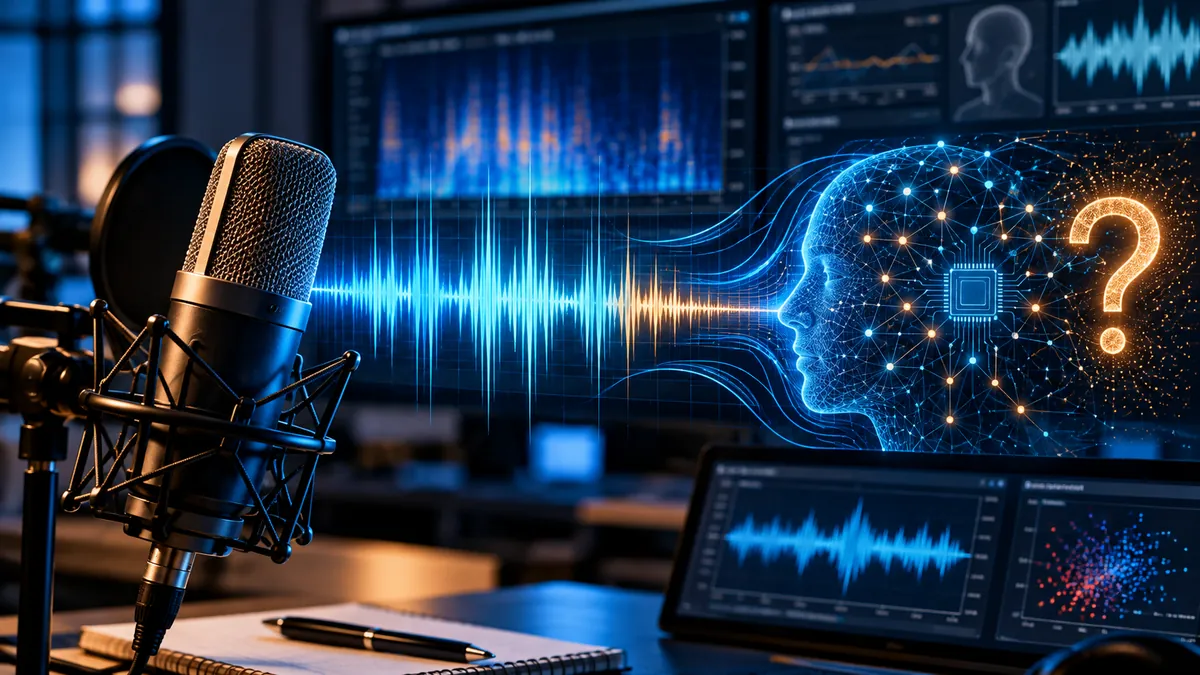
Can AI Detect Lies From Your Voice?
Imagine an app listening to a ten-second voice recording and announcing that the speaker is lying. The result looks scientific: colorful waveforms, a confidence score, perhaps even a percentage labeled “deception.” But what does that number actually measure? Voice-analysis software can identify patterns in sound. Determining whether a statement is factually false, and whether its speaker knowingly intended to deceive, is a much harder task. Those two abilities should never be confused.
The short answer is that researchers are investigating whether artificial intelligence can find speech patterns associated with deception, but there is no scientifically established voice-only system that can reliably identify lies across everyday conversations, languages, speakers, and high-stakes settings. A nervous person may be truthful; a calm person may lie. This guide explains the technology, the strongest available evidence, the methodological pitfalls, and how to evaluate sensational claims responsibly.
What Would It Mean for AI to Detect a Lie?
A lie is not merely an incorrect statement. A person may say something false because they are mistaken, misremembering, joking, speculating, or repeating misinformation. Deception generally involves an intention to mislead. A microphone records acoustic pressure, not the truth of an event or the speaker’s intentions. Even an extremely accurate transcription system cannot infer whether a speaker personally believes the words being spoken.
A meaningful deception detector would need to distinguish intentional dishonesty from honest error, stress, excitement, speech differences, recording artifacts, and cultural communication styles. It would also need independent evidence establishing what actually happened. Without a reliable ground truth, a model may learn what an experimenter calls a lie rather than deception itself.
How AI Voice Analysis Actually Works
1. Recording and cleaning the audio
A typical research pipeline begins with a voice recording. Software may remove background noise, identify periods of speech, separate speakers, and divide a conversation into shorter segments. These preprocessing decisions matter. A quiet studio microphone captures very different detail from a compressed telephone call or a voice message recorded on a busy street.
2. Measuring acoustic features
The system may estimate fundamental frequency (often perceived as pitch), pitch variability, intensity, speaking rate, pauses, rhythm, spectral characteristics, and aspects of voice quality. Some models also analyze mel-frequency cepstral coefficients, which summarize spectral properties used widely in speech recognition. None of these features is a dedicated biological marker of lying. They are measurements that can vary for numerous ordinary reasons.
3. Looking at words and conversational context
Speech-to-text software can produce a transcript. Natural-language models may then analyze uncertainty words, specificity, contradictions, response length, or the relationship between a question and its answer. This moves beyond voice alone. A model that uses transcripts, previous answers, or external facts is doing a different task from an acoustic-only “voice lie detector,” and the distinction should be disclosed clearly.
4. Training a classifier
Researchers give a machine-learning model examples labeled truthful or deceptive. It learns statistical patterns that distinguish the labeled examples in its training data. A neural network may output a score between zero and one, but that score is not automatically a trustworthy probability that a person lied. Calibration, representative training data, and independent testing are needed before interpreting scores probabilistically.
5. Testing on unfamiliar speakers
The crucial test is whether the system works on new people, new microphones, new languages, and new situations—not merely on clips similar to those it already saw. Testing on the same speakers in both training and evaluation can accidentally allow a model to learn identity, accent, or recording conditions instead of deception.
Does Your Voice Change When You Lie?
It can, but not in one universal or reliable way. Some people become tense when they fear being caught, and tension may affect pitch, breathing, timing, or voice quality. Others feel more anxious while telling an uncomfortable truth. Experienced or rehearsed liars may remain composed. A person who is tired, sick, angry, shy, speaking a second language, or answering a stressful question may show changes that have nothing to do with dishonesty.
A major meta-analysis of behavioral cues to deception reviewed 1,338 estimates involving 158 cues. It found some average differences between truthful and deceptive behavior, but average group-level tendencies do not provide a dependable diagnostic test for an individual. The lesson is not that speech contains zero information; it is that weak, context-dependent patterns can be misused when presented as certain verdicts.
What the Scientific Research Actually Shows
The National Academies: voice stress claims lack convincing support
The U.S. National Research Council examined voice stress analysis alongside polygraph-related techniques in its report The Polygraph and Lie Detection. Its assessment was that existing research offered little or no scientific basis for voice-stress instruments as dependable alternatives for detecting deception. Some controlled tests yielded results close to chance, and the report identified serious reliability and validity problems. The report is older than modern deep-learning systems, so it should not be treated as a direct test of today’s neural networks; it remains relevant to the unsupported assumption that vocal stress equals lying.
Psychological science: stress is not a lie-specific signal
The American Psychological Association has emphasized the scientific limits of conventional lie detectors. Physiological arousal and anxiety are not exclusive to dishonesty. The same conceptual problem applies to systems that try to infer deception from vocal tension alone: an observed reaction can have several competing explanations. Better signal processing cannot by itself resolve an ambiguous relationship between the signal and the underlying behavior.
A 2024 analysis warns about AI-based deception detection
A 2024 article in Trends in Cognitive Sciences, “Detecting deception with artificial intelligence: promises and perils,” describes a gap between rapid technical development and the methodological and theoretical foundations needed to support deception-detection claims. The authors call attention to how systems are evaluated and the risks of deploying them prematurely. This is not proof that future progress is impossible; it is a warning that an impressive demonstration is not equivalent to validated real-world reliability.
Why published accuracy numbers require context
An accuracy figure is meaningful only alongside the dataset, sample size, labeling method, class balance, testing protocol, and target population. A model scoring well on acted lies in a laboratory may fail when applied to customer-service calls, border interviews, or spontaneous personal conversations. Some studies analyze the words people say rather than the acoustic voice signal; their findings cannot be used as proof of voice-only lie detection.
The Biggest Problems With AI Lie-Detection Studies
Artificial or low-stakes lies
Many experiments ask volunteers to make up stories or deny an action they were instructed to perform. The participant knows it is an experiment and may have little incentive to deceive convincingly. These samples are easier to label than genuine lies, but the vocal behavior may not resemble real-world deception with social, financial, or legal consequences.
Unreliable ground truth
A researcher must know which statements are intentionally false. In real interviews, independent verification may be difficult or impossible. If labels are based on investigators’ suspicions or disputed confessions, a model may inherit those mistakes. High-quality studies should explain exactly how truth and deception were independently established.
Speaker leakage and dataset shortcuts
Suppose one group of speakers mostly provides truthful clips and another group mostly provides deceptive clips. The model could classify voices by speaker identity rather than honesty. Similar leakage can happen when recordings differ by microphone, room, language, or interview procedure. Speaker-independent and session-independent splits are essential, and ideally the final evaluation uses a separately collected dataset.
Accuracy versus precision, recall, and false alarms
If most statements in a dataset are truthful, a model can achieve apparently strong accuracy by predicting “truth” almost every time. More informative measures include sensitivity to deceptive statements, specificity for truthful statements, precision of lie accusations, and false-positive rates. For high-stakes use, even a modest false-positive rate can harm many innocent people.
Different languages and communication styles
Pitch range, speech rhythm, politeness conventions, hesitation, and storytelling styles vary across languages and communities. An English-language model trained on a narrow sample may perform poorly on speakers of French, Spanish, German, or Arabic, and even among different accents within the same language. Validity must be demonstrated for the intended population rather than assumed.
Audio quality and deliberate manipulation
Background noise, compression, microphone distance, voice enhancement, and voice cloning can alter acoustic features. A system that changes its verdict when the same clip is compressed or denoised is not stable enough to support serious conclusions. Someone can also deliberately slow their speech or change vocal delivery without changing whether the statement is true.
Can AI Detect Lies Better Than Humans?
Humans are generally not excellent at distinguishing truths from lies without corroborating evidence. Psychological research has found that unaided judgments often hover only modestly above chance on average. An algorithm could outperform human judgments on a specific benchmark while still being unsuitable for real-world accusations. “Better than people in this experiment” is a narrower claim than “can tell when anyone is lying.”
A rigorous comparison would use the same previously unseen recordings, specify the evaluation metric, and include uncertainty ranges. It would also test whether the algorithm provides useful information beyond basic contextual evidence, rather than merely producing a persuasive-looking score.
Voice Stress Analysis Is Not the Same as Modern AI
Traditional computer voice stress analyzers claimed to infer deception from features such as frequency changes or supposed vocal microtremors. Modern AI may instead combine large collections of acoustic features, speech transcripts, and deep neural networks. Their engineering differs, but both face the same fundamental challenge: the absence of a unique, consistent acoustic signature of intentional dishonesty. It would be inaccurate to say all modern AI models have been conclusively disproved by older voice-stress studies; it would be equally inaccurate to claim that adding a neural network solves the validity problem.
What About Real-Time AI Lie Detector Apps?
Some consumer apps offer instant “truth scores” from recordings or live conversations. Treat these as unverified entertainment unless the developer publishes strong independent evidence for the specific product and intended use. A glossy interface, waveform animation, testimonial, or high percentage on a promotional page does not establish scientific validity.
- Look for peer-reviewed or independently audited validation using speakers and recordings absent from training.
- Check whether the system is acoustic-only or secretly relies on transcripts, scripted prompts, or other context.
- Ask how the truth labels were verified and whether test cases involved meaningful real-world consequences.
- Examine false accusations of truthful speakers, not only detection of deceptive samples.
- Look for results across languages, accents, ages, recording conditions, and relevant populations.
- Check whether the vendor explains uncertainty, privacy practices, and appropriate limits on use.
Why an 85% Accuracy Claim May Be Misleading
Imagine a hypothetical screening tool used on 1,000 statements, of which only 100 are intentionally deceptive. Assume, purely for illustration, it detects 80% of lies and correctly clears 80% of truthful statements. It would flag 80 real lies but also falsely flag 180 truthful statements. Of its 260 accusations, only about 31% would be correct. These are invented numbers to demonstrate the effect of base rates—not measured performance of any commercial product. The example shows why sensitivity and specificity, prevalence, and the cost of false accusations matter more than a single headline accuracy figure.
Potential Uses—and Why Each Needs Separate Validation
Customer support and fraud prevention
A business may want to identify suspicious calls, but voice-based lie accusations could unfairly target nervous customers, people with speech disorders, or speakers using a second language. Identity verification, transaction anomalies, account controls, and independently corroborated facts are often more defensible sources of evidence. A fraud risk score is not a verdict about a person’s honesty.
Job interviews and employee screening
Using an unvalidated voice lie detector to reject applicants risks false accusations and unequal outcomes. Applicants may be anxious for many legitimate reasons. Any employment use would require careful legal, privacy, accessibility, and discrimination review in the relevant jurisdiction, in addition to compelling scientific validation.
Police interviews and legal disputes
A false positive in a criminal investigation can have severe consequences. An AI output should not substitute for independently verified facts, lawful investigative methods, or due process. The reliability required for serious legal decisions is much higher than the standard for a laboratory demonstration.
Personal relationships
Recording a partner or friend and asking an app to judge their honesty is particularly risky. A misleading result can damage trust, and recording conversations may raise consent and privacy issues depending on location. A model’s score cannot establish someone’s intentions, feelings, or fidelity.
Privacy Risks of Uploading Voice Recordings
A voice recording can contain sensitive personal information, other people’s speech, and distinctive characteristics of a speaker. Some systems may process audio remotely, store transcripts, or retain recordings for product improvement. Before uploading a conversation, check whether you have permission to record and share it, how long the service retains data, whether recordings are used for model training, and how deletion requests work. Avoid submitting confidential medical, legal, employment, or family conversations to a consumer “lie detector.”
How to Evaluate a Research Paper on Voice-Based Deception
- Identify the exact task: intentional lying, stress recognition, emotion classification, or factual verification.
- Read how participants were recruited and how many unique speakers were included.
- Check whether lies were spontaneous, instructed, acted, or related to genuine stakes.
- Confirm that speakers, sessions, and recording environments were separated between training and testing.
- Inspect the confusion matrix, false-positive rate, confidence intervals, and class balance.
- Look for an external test set collected by different researchers or in a different environment.
- Compare audio-only performance with transcript-only and combined approaches.
- Check whether code, dataset details, and limitations are disclosed.
What AI Can Reliably Do With Voice Today
AI systems can perform useful speech tasks, such as transcription, speaker diarization, noise reduction, language identification, and—in certain conditions—classification of vocal patterns. Those capabilities do not mean a model knows whether a person is telling the truth. For example, a transcript can help an investigator identify inconsistent dates for independent checking; it cannot prove that an inconsistency was intentional deception. The most responsible role for AI is to assist evidence review rather than pronounce guilt or dishonesty from a voice recording.
Could Future AI Become a Reliable Lie Detector?
It is possible that better data, improved experimental designs, and multimodal context will reveal more useful patterns for particular constrained tasks. Yet a fundamental obstacle remains: truthfulness is about facts, beliefs, and intentions, while voice is an indirect behavioral signal. Progress would require prospective validation in realistic settings, transparent error rates, external replication, fairness testing, and safeguards against misuse. A future model might help identify questions worth verifying without being able to determine deception conclusively.
Practical Takeaways
- Do not assume a higher pitch, shaky voice, long pause, or nervous laugh proves lying.
- Treat consumer voice lie-detector scores as unverified unless the exact product has convincing independent validation.
- Prefer corroborating records, timelines, documents, and direct factual checks when accuracy matters.
- Do not use voice-analysis scores alone for hiring, policing, medical, financial, or relationship decisions.
- Protect consent and privacy before recording or uploading another person’s voice.
- When reading studies, examine the test population and false-positive rate before trusting the advertised accuracy.
Conclusion: AI Can Analyze a Voice, Not Read a Mind
Artificial intelligence can detect statistical patterns in sound, and deception research is a legitimate scientific field. But a voice is not a direct window into truth or intent. Existing evidence does not justify treating AI voice analysis as a universal, dependable lie detector. The strongest approach is skepticism toward definitive scores, careful attention to how systems are validated, and reliance on independently verifiable evidence when the stakes are real.
Sources and Further Reading
National Academies — The Polygraph and Lie Detection, chapter on alternative techniques
American Psychological Association — Do Lie Detectors Work?
DePaulo et al. (2003) — Cues to Deception, Psychological Bulletin
Vrij (2019) — Deception and Truth Detection When Analyzing Nonverbal and Verbal Cues
You may also like
 Science & Discoveries
UK November Cold Snap: What the Met Office Forecast Says
What the Met Office forecast says about the UK November cold snap, possible northern wintry showers, frost and…
 Psychology
Does Anger Make You Overestimate Your Intelligence? The Research Explained
Research links trait anger with inflated self-rated intelligence in some groups. Learn what the 2018 study found, what…
 Psychology
Pathological Lying: Signs, Causes, Treatment, and What Research Shows
What is pathological lying? Explore the signs, research on compulsive lying, DSM-5-TR status, treatment limits and safe ways…