
Anthropic IPO: Proposed ANT Ticker, SEC Filing and Key Facts
Anthropic’s proposed ANT listing explained through original filings, a verified financial reconciliation, real source screenshots and a practical update checklist.
Contents
- What is confirmed about the Anthropic IPO?
- Why the public S-1 matters
- ANT is the proposed ticker for Class A shares
- How to check Anthropic’s IPO documents yourself
- 1. Start with the dated company announcement
- 2. Check the SEC filing detail page
- 3. Read the cover before the financial headlines
- 4. Follow the latest version
- Reading the financial statements: three different results
- An accounting bridge to the $80.748 billion net loss
- Match the period before comparing performance
- Share price, valuation and money raised are different numbers
- Retail access: IPO allocation and exchange trading
- Governance: voting power needs its own reading
- Read the AI risks as business disclosures
- Verify any offer of pre-IPO Anthropic access
- A practical record for the next update
- Original sources and verification

Anthropic has publicly filed for a proposed initial public offering, but its shares have not started trading through that offering. The company behind Claude announced its Form S-1 filing on October 26, 2026, and intends to list Class A common stock on the Nasdaq Global Select Market under the symbol ANT. Its announcement leaves the offering’s share count and price range undetermined.
Last checked: October 27, 2026. The public registration reviewed for this guide is preliminary. A ticker, a prospectus and a predicted listing window represent different stages of the process. None supplies a final IPO price or guarantees that a retail investor will receive shares.
The useful questions now are practical: which terms are confirmed, how can you check the next filing, and what do the financial statements actually say? This guide includes a reproducible reading method, an accounting bridge for the headline loss, and a worked example separating share price, valuation and money raised.
What is confirmed about the Anthropic IPO?
The starting point is Anthropic’s October 26 announcement, checked against the SEC filing record. Here is the status of the main terms in the documents reviewed on October 27.
| Item | Verified position | How to interpret it |
|---|---|---|
| Public registration | Form S-1 filed October 26, 2026 | A preliminary public offering document is available |
| Proposed security | Class A common stock of Anthropic, PBC | Identify the legal issuer and share class |
| Proposed exchange and symbol | Nasdaq Global Select Market; ANT | These are proposed listing details, rather than evidence of completed trading |
| Offering price range | Not yet determined in the announcement | A number on a promotional page is not a confirmed IPO price |
| Number of shares offered | Not yet determined in the announcement | The final size of the offering cannot yet be calculated from those terms |
| Final first trading date | No committed date in the company announcement reviewed | Treat reported timetables as expectations until supported by later official documents |
| Registration effectiveness | The October 26 announcement says the registration statement was not yet effective | Follow subsequent SEC records rather than assuming filing means completion |
This snapshot is deliberately dated. An amended prospectus can change the answer quickly, especially for pricing, the number of shares and the planned timetable.
Why the public S-1 matters
A public S-1 gives readers something more substantial than a valuation headline: a document containing the proposed offering terms, financial statements, business description, ownership arrangements and risk disclosures. The October 26 registration statement is therefore the central reference for checking claims about the deal.
It also has a version problem. A summary based on an earlier draft can remain online after a new filing appears. Before comparing two articles, establish whether they describe the same document, reporting period and stage of the offering. A changed number may reflect a newer disclosure rather than an arithmetic error.
The SEC reviews registration disclosures, but effectiveness is not an endorsement of an investment. Investor.gov’s IPO investor bulletin explains that distinction and the role of the prospectus.
ANT is the proposed ticker for Class A shares
A ticker helps identify a security on an exchange. Here, the important combination is Anthropic, PBC + Class A common stock + proposed Nasdaq symbol ANT. Checking all three is more reliable than recognizing a familiar company name or logo.
A financial website can create an informational page before a security begins trading. A watchlist entry, an empty quote screen or a page labelled “upcoming IPO” does not establish an executed trade. A displayed value also needs a definition: it might refer to a private transaction, a hypothetical instrument or a different security altogether.
For the same reason, access to Claude is separate from ownership of Anthropic. A subscription, API account or third-party app using Claude does not itself give the customer shares, voting rights or an IPO allocation.
How to check Anthropic’s IPO documents yourself
1. Start with the dated company announcement
Open the official announcement and note its publication date. Read the statements about the security, listing venue, price range and registration status. Check whether a later announcement updates them before relying on this earlier snapshot.

2. Check the SEC filing detail page
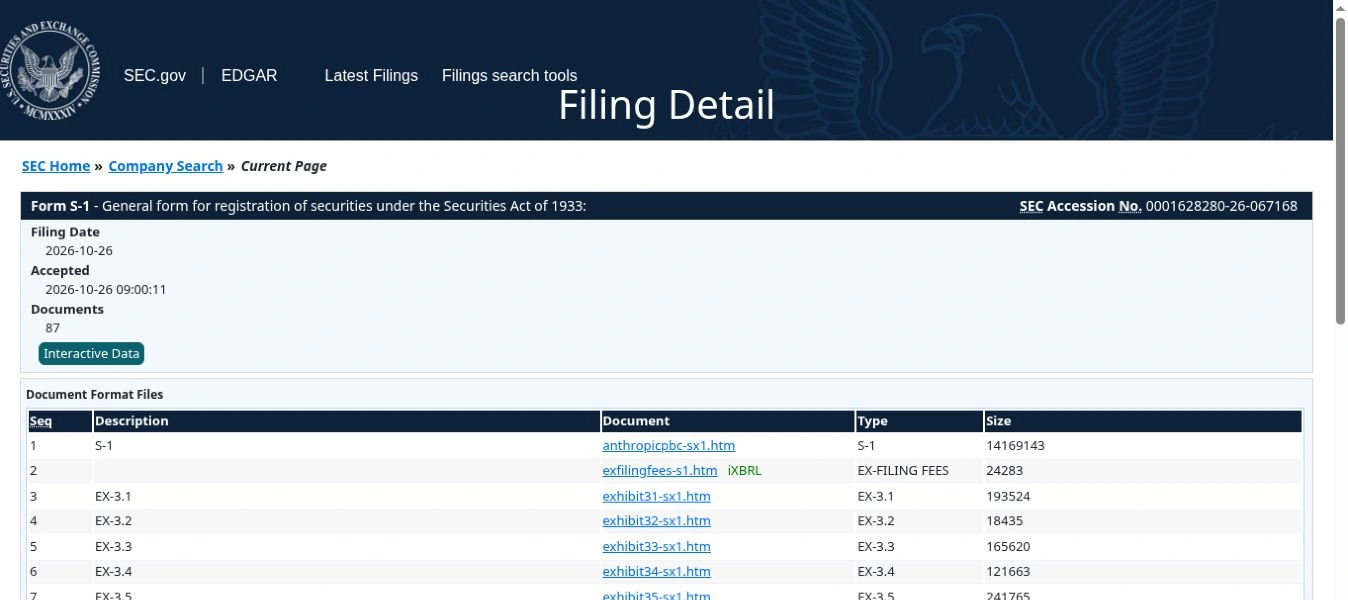
The filing detail page for the October 26 S-1 records the filing date and accession number 0001628280-26-067168. The company identifier is CIK 0002130357. These identifiers help distinguish the actual filing from commentary about it.
In the document list, open the entry whose type is S-1, named anthropicpbc-sx1.htm. The other entries include exhibits and graphics. Opening an exhibit instead of the main prospectus can leave you looking at a valid document that does not contain the terms you need.
3. Read the cover before the financial headlines
On the prospectus cover, locate the issuer, share class, proposed exchange, symbol, offering share count and price range. In the October 26 version, the numerical pricing fields remain blank. A blank field means the document does not yet provide that term; it is not an invitation to substitute a forecast.
Use your browser’s Find function for initial public offering price, Use of Proceeds and Principal and Selling Stockholders. Then read the surrounding section. Searching is a navigation aid; the full paragraph, table headings and footnotes determine what a match means.
4. Follow the latest version
Use EDGAR’s “see all company filings” link to look for subsequent documents. An S-1/A is an amendment. A later final prospectus, commonly filed as 424B4, is important for final offering terms. Check the document’s actual content and date rather than treating its form label alone as proof that a particular milestone is complete.
Keep a short record: document date, form type, price range, share count, and the official source for any trading date. This takes little space and prevents an old screenshot or saved article from becoming your current source by accident.
Reading the financial statements: three different results
Anthropic’s summary statements show $16.286 billion of revenue for the six months ended June 30, 2026, compared with $1.163 billion in the equivalent 2025 period. Dividing the two gives approximately 14.0 times the earlier revenue. That is historical half-year growth, rather than a forecast for the next year.
The same 2026 period records a $693 million operating loss and an $80.748 billion net loss. Those results belong to different lines of the income statement. The large gap is a reason to examine the reconciliation, not to choose whichever number supports a preferred story.
| Measure, billions of US dollars | First half 2025 | First half 2026 |
|---|---|---|
| Revenue | 1.163 | 16.286 |
| Operating result | −2.135 | −0.693 |
| Net result | −12.969 | −80.748 |
| Net cash from operating activities | −1.513 | +3.929 |
Source: the S-1’s summary financial data and cash-flow disclosures. The interim six-month financial statements are unaudited. They should not be described as audited annual results. The figures above also do not represent full-year 2026 results.
Revenue measures recognized sales. Operating result deducts operating expenses. Net result includes additional items such as financing-related remeasurements, other income or expenses, and taxes. Operating cash flow starts with the net result and reconciles non-cash items and movements in operating assets and liabilities.
For readers checking the growth calculation, our guide to percentage change and common calculation mistakes explains why “14 times the earlier value” and “a 1,400% increase” are different statements. Fourteen times a starting value corresponds to approximately a 1,300% increase.
An accounting bridge to the $80.748 billion net loss
The following bridge uses the first-half 2026 income-statement lines, expressed in billions of dollars. Positive values add income; negative values subtract from the result.
| Step | Amount, US$ billions |
|---|---|
| Operating loss | −0.693 |
| Add interest income | +1.111 |
| Fair-value change in convertible notes, derivative liabilities and simple agreements for future equity (SAFEs) | −72.388 |
| Other income and expense, net | −8.757 |
| Income-tax provision | −0.021 |
| Resulting net loss | −80.748 |
Adding those five components reproduces the reported net loss. The $72.388 billion fair-value expense is a major part of the explanation. The filing links the remeasurement primarily to increases in the value of outstanding convertible notes as the company’s enterprise valuation increased.
It would still be wrong to subtract that one expense and call the remainder “cash burn.” The cash-flow statement contains additional adjustments. For this half-year, operating activities provided $3.929 billion, investing activities used $17.181 billion, and financing activities provided $110.774 billion. Each category answers a different question. Cash raised through financing is not recognized sales revenue, and investing outflows should not be relabelled as the operating loss.
A non-cash accounting charge can affect reported earnings without an equal cash payment during the period. That does not make the underlying financing arrangements economically irrelevant: their terms can affect future ownership, obligations or dilution. Likewise, positive operating cash flow for six months does not establish that all infrastructure investment is funded or that future periods will look the same.
Match the period before comparing performance
Comparing a six-month figure with a full-year figure changes the question. Annualizing a half-year amount by multiplying by two creates a simple calculation, not a company forecast. It can miss changes in demand, capacity, payment timing and costs.
Also distinguish results under US generally accepted accounting principles (GAAP) from adjusted measures. An adjusted metric removes specified items under the company’s definition. Read the reconciliation before comparing it with GAAP profit or with another company’s adjusted number. A familiar label does not ensure that two calculations exclude the same expenses.
Share price, valuation and money raised are different numbers
An IPO headline may use several large dollar figures. Before comparing them, identify what each one measures.
| Term | What it measures | What else you need |
|---|---|---|
| Offering price | Price per share for shares allocated in the IPO | Final pricing terms and the relevant share class |
| Equity valuation or market capitalization | A value for the company’s equity | A clearly defined share count and valuation basis |
| Gross primary proceeds | Money from new shares sold by the company before costs | Number of new shares multiplied by their price |
| Opening market price | Price at which exchange trading opens | An actual trading market and execution data |
Hypothetical example, using invented numbers rather than Anthropic estimates: suppose a company has 1 billion shares after an offering, priced at $50 each. On that simplified share-count basis, its equity value is $50 billion. If only 50 million shares are newly issued, those new shares raise $2.5 billion before fees and expenses.
The company would not receive the full $50 billion. That figure values the equity across all counted shares. If existing holders also sell shares, the money from their sales goes to those holders. The Anthropic prospectus explicitly distinguishes company proceeds from selling-stockholder proceeds.
Now suppose this imaginary stock opens at $70. One hundred shares bought at that market price would cost $7,000 before charges; an allocation of 100 shares at the $50 offering price would cost $5,000. The $2,000 difference illustrates why reading the final offer price does not guarantee access to shares at that price.
For Anthropic, the missing offering terms mean this arithmetic should remain a method, not a price prediction. A private-round valuation, a reported target valuation and a final public offering valuation can use different dates, rights and share-count assumptions. They should not be substituted for one another.
Retail access: IPO allocation and exchange trading
Buying shares allocated in an IPO and buying shares after public trading begins are separate routes. In an allocation, the investor receives shares through a participating intermediary under that offering’s terms. In the public market, an order is executed against available buying and selling interest after trading has opened.
Investor.gov explains that a broker cannot guarantee an IPO allocation. Having an account or submitting interest does not, by itself, establish that a particular investor will receive the requested number of shares.
Access also depends on the offering and intermediary. Readers in the UK, Canada and other markets should check the relevant offering restrictions and their broker’s permitted products. A US registration statement does not promise identical access to every retail investor worldwide.
There is no need to invent a broker list before participation is confirmed. The practical checks are the legal security being offered, the official terms, the intermediary’s authorization, and whether the transaction is an IPO allocation or a later market purchase. Those checks remain useful even when the proposed timetable changes.
Governance: voting power needs its own reading
The prospectus proposes a governance structure in which a Founder LLC holds Class F stock carrying 50.1% of voting power on matters submitted to stockholders generally. Class A shares carry one vote each. The Long-Term Benefit Trust also has separate rights relating to Class T directors, who are intended to constitute a majority of the authorized board.
These are different kinds of control. The 50.1% voting figure does not mean the founders necessarily own 50.1% of the economic value, or that this ordinary-voting arrangement describes every board appointment. Read the cover and “Description of Capital Stock” together when interpreting shareholder rights.
The filing also describes Anthropic as a public benefit corporation. Its governance framework involves balancing interests beyond a conventional focus on shareholder returns alone. That is a feature of the disclosed structure to understand, rather than a label that establishes an investment’s future performance.
Read the AI risks as business disclosures
The risk section deserves attention alongside the growth figures. For a model developer, computing access, suppliers, competition, product reliability, misuse, legal disputes and regulation can affect costs, distribution and demand. The useful task is to connect each risk with the business mechanism through which it could matter.
For example, a dependency on an outside computing provider raises questions about availability, commitments and alternatives. A model-safety risk raises questions about testing, deployment decisions, restrictions and customer trust. A governance provision raises questions about which decisions public shareholders can influence.
Risk language is not a prediction that every described outcome will occur. Equally, a long list should not be dismissed merely because prospectuses routinely contain warnings. Read the company’s specific description and the surrounding qualifications.
Warnings about strategic or self-preserving model behavior also do not, by themselves, settle whether AI has subjective experience. Our explanation of AI consciousness and human judgments separates questions about observable behavior from claims about consciousness.
Verify any offer of pre-IPO Anthropic access
Anthropic has published a specific warning about unauthorized stock sales. The notice reviewed for this article, dated June 29, 2026, says unapproved transfers are void under its restrictions and that transfers to special purpose vehicles are not permitted. Those company-specific restrictions matter when evaluating an offer labelled “pre-IPO access.”
Before treating an offer as ownership of Anthropic shares, establish:
- The instrument: direct company shares, an interest in a fund or SPV, a forward contract, and a token are different arrangements.
- Recognition: identify the issuer’s current transfer policy and the basis on which the proposed ownership would be recognized.
- The seller: verify the identity and regulatory status of the person or firm making the offer.
- The evidence: a familiar logo, a certificate or an asserted IPO date does not replace official documentation.
The SEC’s pre-IPO investor alert describes risks involving misleading access claims and high-pressure promotion. This is a reason to verify a specific offer, not to assume that every private transaction or every investment fund has the same legal structure.
Any eventual registered public offering must be assessed under its own final documents. An earlier private-transfer policy and a later public allocation are not interchangeable sets of terms.
A practical record for the next update
Keep the following fields together when a new announcement appears. The objective is to identify what changed, rather than repeatedly replacing one predicted listing date with another.
| Question to update | Evidence to record |
|---|---|
| Has the offering document changed? | Latest filing date, form and accession number |
| Is a price range now stated? | Numerical range and the dated prospectus containing it |
| How many shares are being sold? | Separate company-issued shares from selling-stockholder shares |
| Are final terms available? | Final pricing announcement and applicable final prospectus |
| Has exchange trading actually started? | Verified exchange information and a live market, distinct from an upcoming-IPO page |
When a new version appears, record the old and new terms alongside the filing date. Keeping that short change record makes it easier to identify which earlier claims have become outdated and which facts remain supported.
Original sources and verification
- Anthropic: public S-1 announcement, October 26, 2026.
- SEC EDGAR: filing detail and document list.
- Anthropic Form S-1: cover, financial data, cash flows, governance and risks.
- Investor.gov: investing in an IPO.
- Investor.gov: eligibility for IPO allocations.
- Anthropic: unauthorized stock sales and investment scams.
- Investor.gov: pre-IPO investment scams.
Verification date: October 27, 2026. Financial comparisons use the periods and units stated in the preliminary filing. The valuation example is fictional arithmetic. This article explains public documents and is not a recommendation to buy or sell securities.
You may also like
 Artificial Intelligence
Why Do We Deny AI Consciousness Even When It Behaves Like a Human? What a 2026 Study Reveals
A study of 1,092 UK participants found that people rate human agents as more conscious than AI even…